Make daily kitchen essentials look intentional, not cluttered. Learn the “home + boundary” rule, styled counter zones, and easy setups for boards, utensils, ...
The One-In-One-Out Rule for Small Homes

Published
When I lived in a studio apartment, I could tell I was slipping into clutter creep the moment I started doing the tiniest little shuffles: moving a pile from the chair to the bed, then from the bed to the floor, then “just for now” onto the counter. Nothing felt dramatic. But my home felt smaller every week.
The one-in-one-out decluttering method can help with that problem in the most boring, effective way possible. It is an inventory rule. If something new comes in, something equivalent goes out. Not someday. Not after you reorganize. Ideally, that day.
Below is how I use the rule in a busy household (two kids, one dog, and a talent for accumulating water bottles), plus the guidelines that keep it fair, realistic, and actually sustainable.
What it is
One-in-one-out is a boundary that can keep “lifestyle creep” from turning your cabinets, closets, and floors into storage units.
Here’s the clean definition:
- When one item comes into your home, one item leaves your home in the same general category.
- The “out” happens quickly, or within a short, defined window (I use 24 hours for most things).
- You do not add new storage to avoid the decision. The point is to keep your inventory stable.
It is less about becoming a minimalist and more about protecting your daily breathing room.
Why it helps in a small home
Compact homes do not have many “buffer zones.” In a larger house, extra stuff can hide in a basement, guest room, or big garage. In an apartment or smaller family home, overflow turns into visible piles fast.
One-in-one-out tends to work well because:
- It stops the build-up at the front door. You are making the decision while the new item is still in your hand.
- It protects the space you already organized. You can maintain order without constant full-home declutters.
- It can reduce mental load. Fewer items usually means fewer choices, fewer piles, and less “where did I put that?” energy.
House rules that prevent loopholes
One-in-one-out works best when your rules are clear enough to follow when you are tired, rushed, or feeling sentimental.
1) Define your categories
Keep categories simple. If they are too specific, you will loophole your way around them.
- Clothes (adult)
- Clothes (kids)
- Shoes
- Kitchen tools
- Mugs and water bottles
- Books
- Toys
- Beauty and skincare
- Coats and bags
If you want the method to actually hold, pick the categories that are currently overflowing, not the ones you already have under control.
2) Decide what counts as “in”
In my house, these count as “in”:
- Purchases
- Gifts
- Hand-me-downs
- Freebies from events
- “I am borrowing this forever” items
My personal rule is: if it stays in our home longer than a week, I treat it as an “in.” (You can set a shorter or longer window. The point is that you decide it ahead of time.)
3) Decide the timing
My simplest version:
- Most items: out within 24 hours.
- Clothing: out after the first successful wear, within 7 days. (This keeps you from donating something you regret if the new item does not fit or is uncomfortable.)
- Kid items: out the same day if possible, or by the end of the weekend.
4) Decide what counts as “out”
This is the rule that keeps the system honest:
- “Out” means it leaves your home. Donation drop-off, giving it to a friend, selling it quickly, recycling where your local program accepts it, or trash if it is broken or unhygienic.
- Staging is not “out.” A bag by the door is fine as an outgoing zone, but the decision is already made.
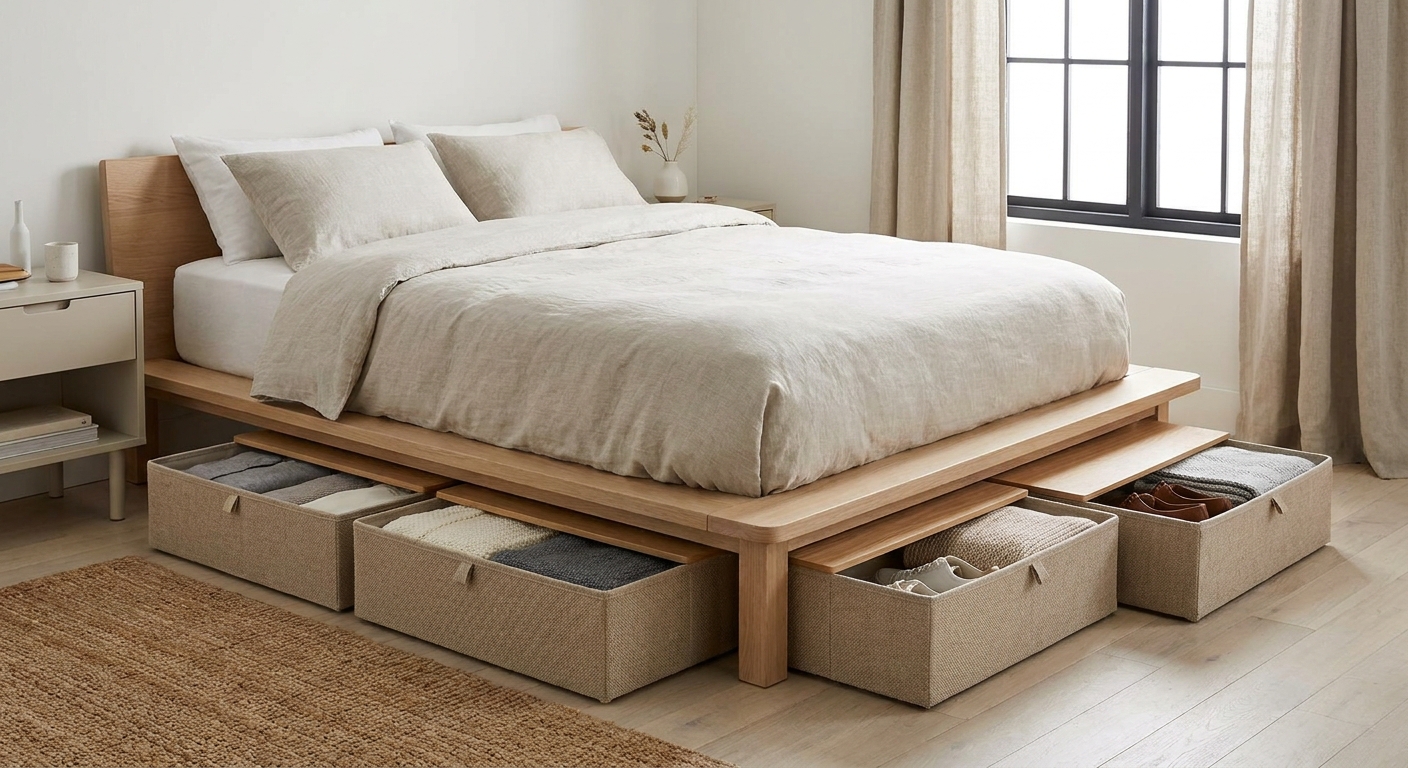
- Long-term storage is a separate category. If you use under-bed bins or a hall closet for seasonal items, give it a firm container limit. When it is full, something has to leave that storage category before anything new stays.
5) Choose your “out” channels
You need a realistic exit ramp. If donating is difficult where you live, make the “out” options broader.
- Donation drop-off
- Text a friend and pass it along
- Sell if you truly will do it quickly
- Recycle textiles where available (and accepted locally)
- Trash if it is broken or unhygienic
One-in-one-out is not a morality test. It is a space-saving system. If an item is genuinely unusable, it does not deserve to live in your home because you feel guilty.
Start with three pressure points
If you try to apply the rule to everything on day one, it can feel like you are living under a microscope. Instead, start where clutter hurts you most.
For many homes, the top three are:
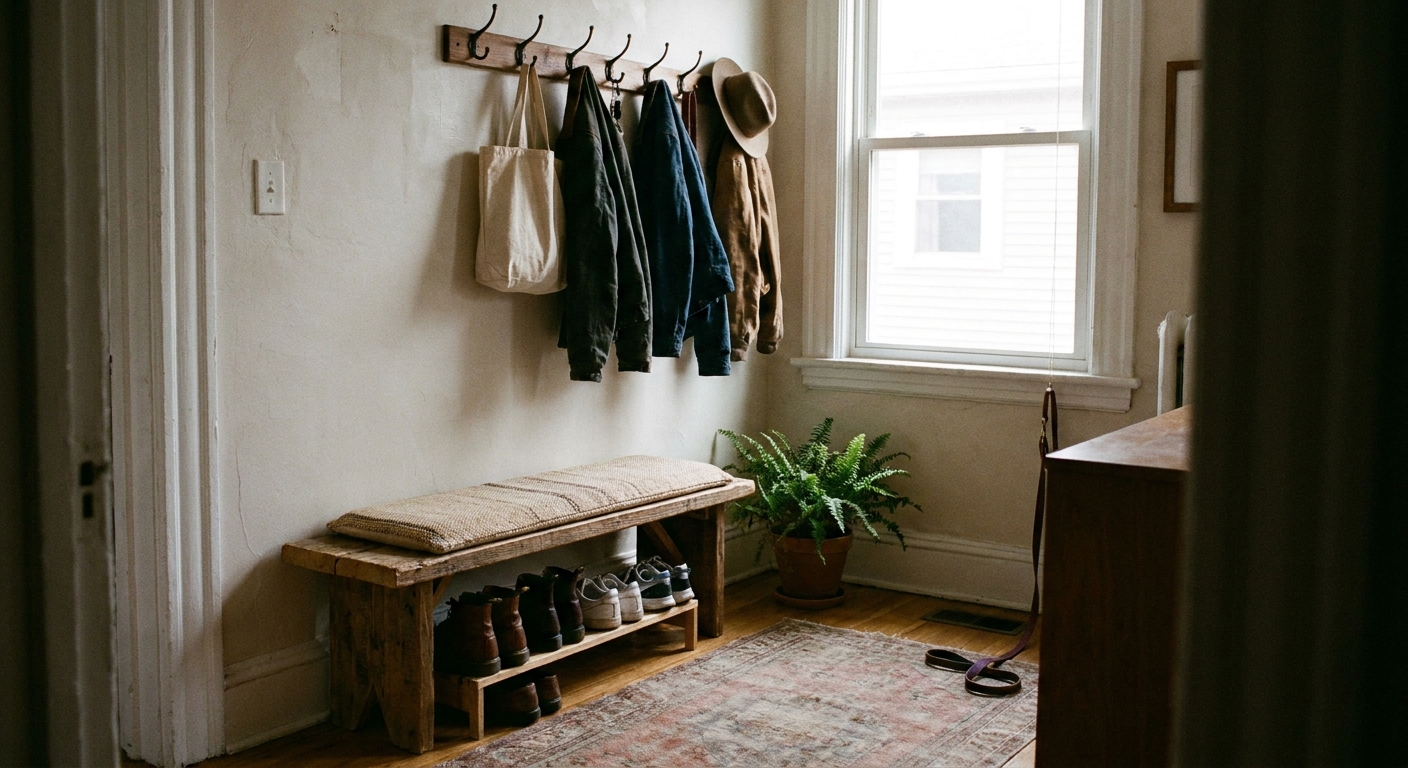
- Entryway: shoes, coats, bags, sports gear.
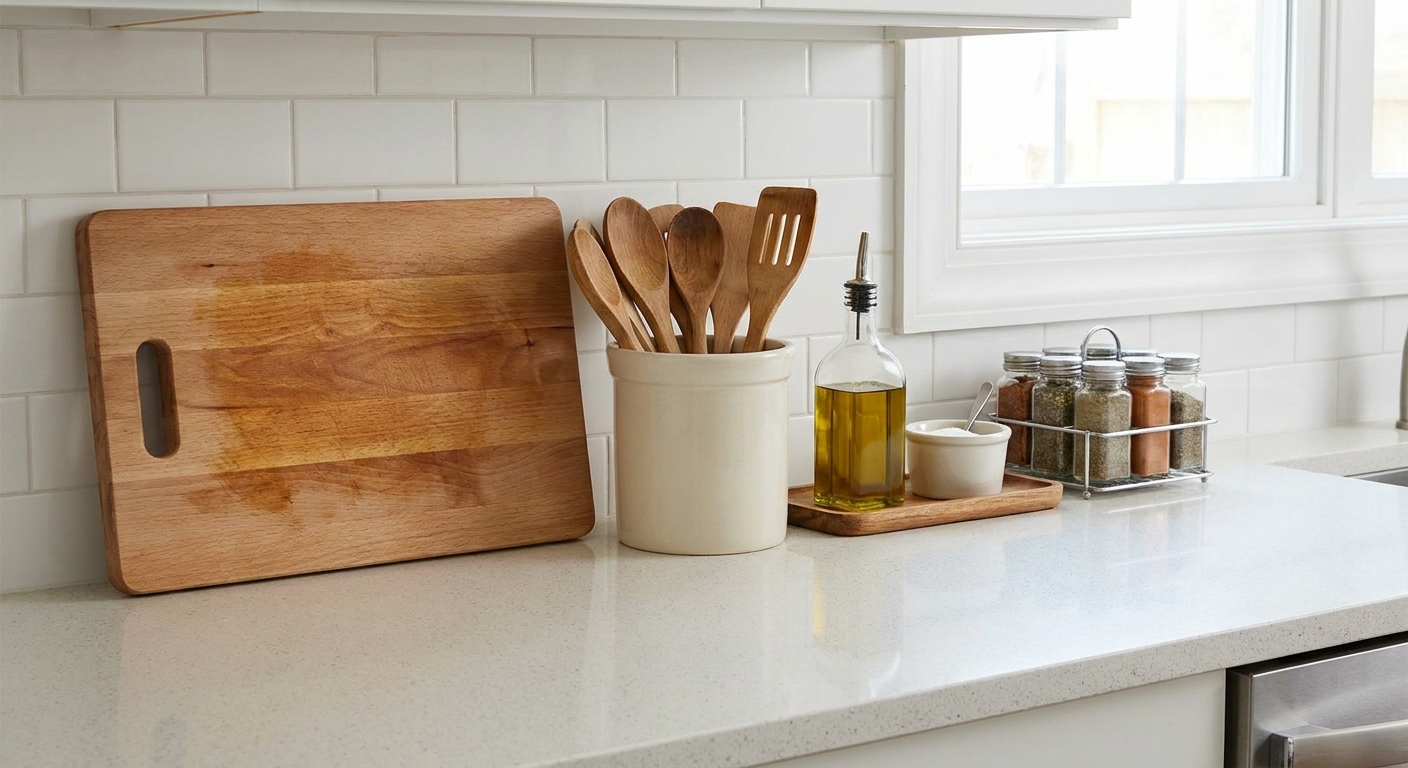
- Kitchen counters: gadgets, mugs, food containers.
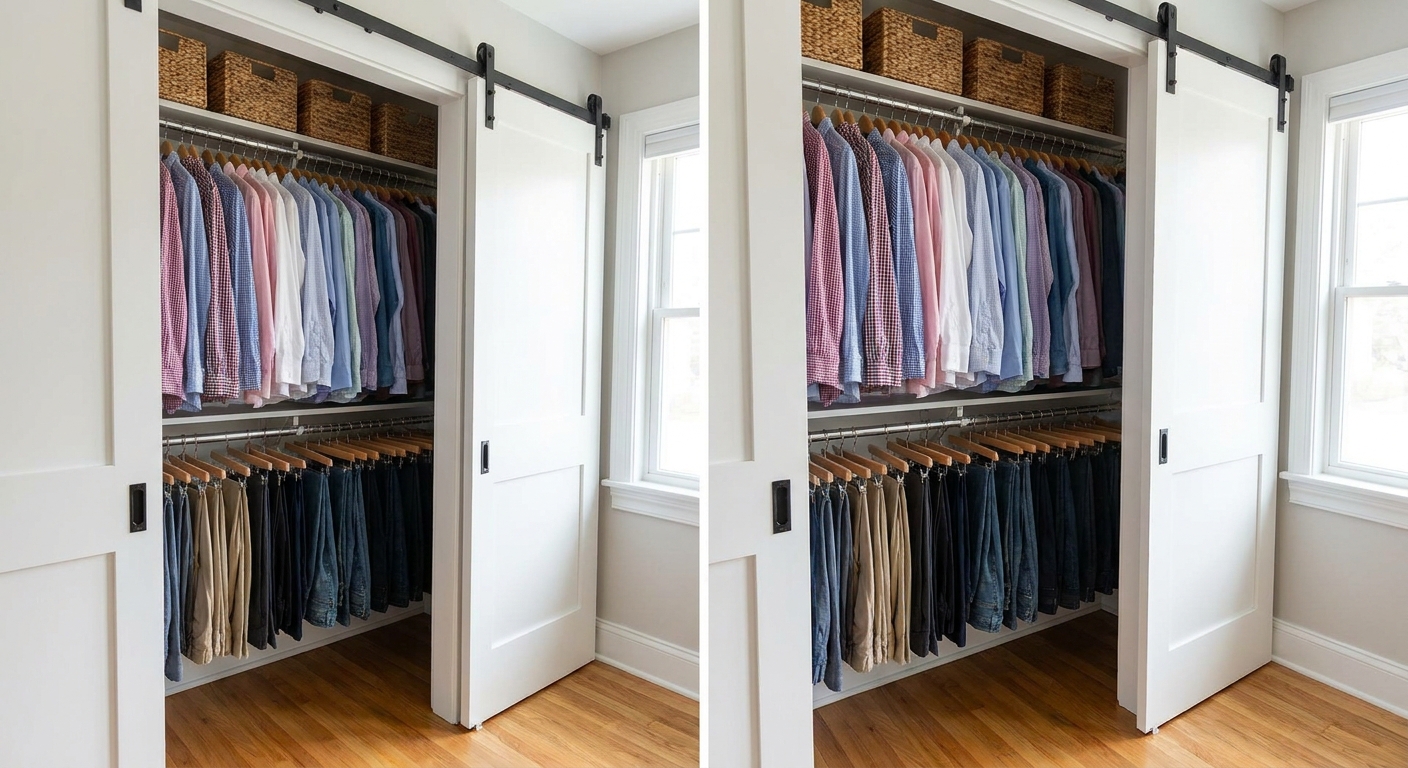
- Bedroom closets: clothing and “just in case” items.
If your counters are your stress trigger, pair this method with a countertop reset. My approach is in Beautiful Kitchen Countertop Organization.
Room-by-room
Entryway
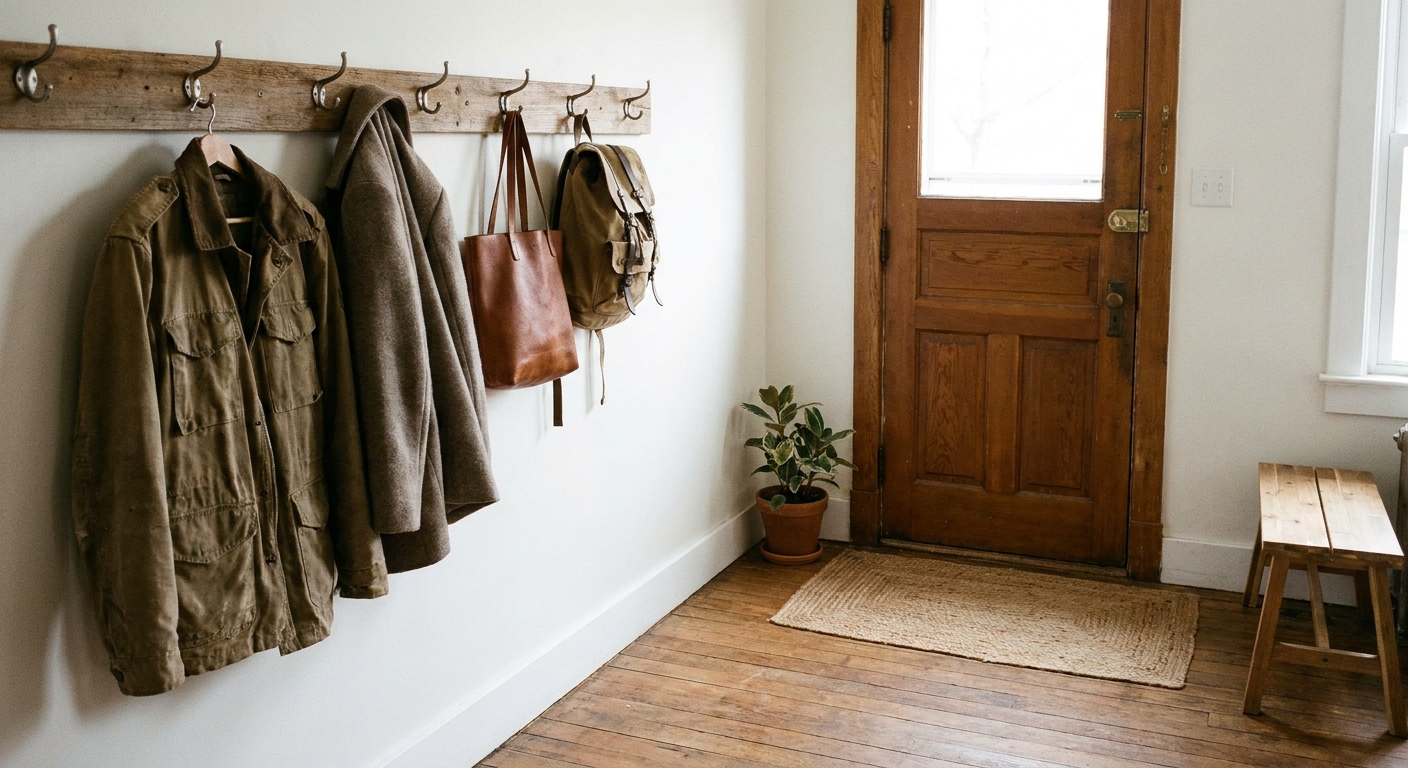
The entry is where clutter becomes a daily obstacle course. My rule here is blunt: if it does not fit in the existing drop zone, something needs to leave.
- New pair of shoes: donate or toss one pair you do not reach for.
- New backpack or tote: choose one to pass on immediately.
- New coat: one coat out, and also check for duplicates (how many black hoodies does one person need?).
If you need a defined landing spot for daily items, I walk through a simple setup in Plan a Small Entryway Drop Zone.
Kitchen
The kitchen is where good intentions multiply into gadgets. That avocado tool you used twice. The second set of measuring cups because they were cute. The mug shelf that quietly became a crowd.
- New mug in: one mug out, even if the new one was a gift.
- New container set: let go of stained, lidless, or mismatched pieces the same day. (Recycle only what your local program accepts. When in doubt, trash is better than “recycling” that just becomes contamination.)
- New gadget: one gadget out, or one bulky duplicate out (do you really need a blender and a smoothie blender and an immersion blender?).
If your cabinets are bursting, do not buy more bins first. Try vertical add-ons like shelf risers and tension rods. I break down options in Add More Kitchen Cabinet Space With Shelf Risers and Tension Rods.
Closets
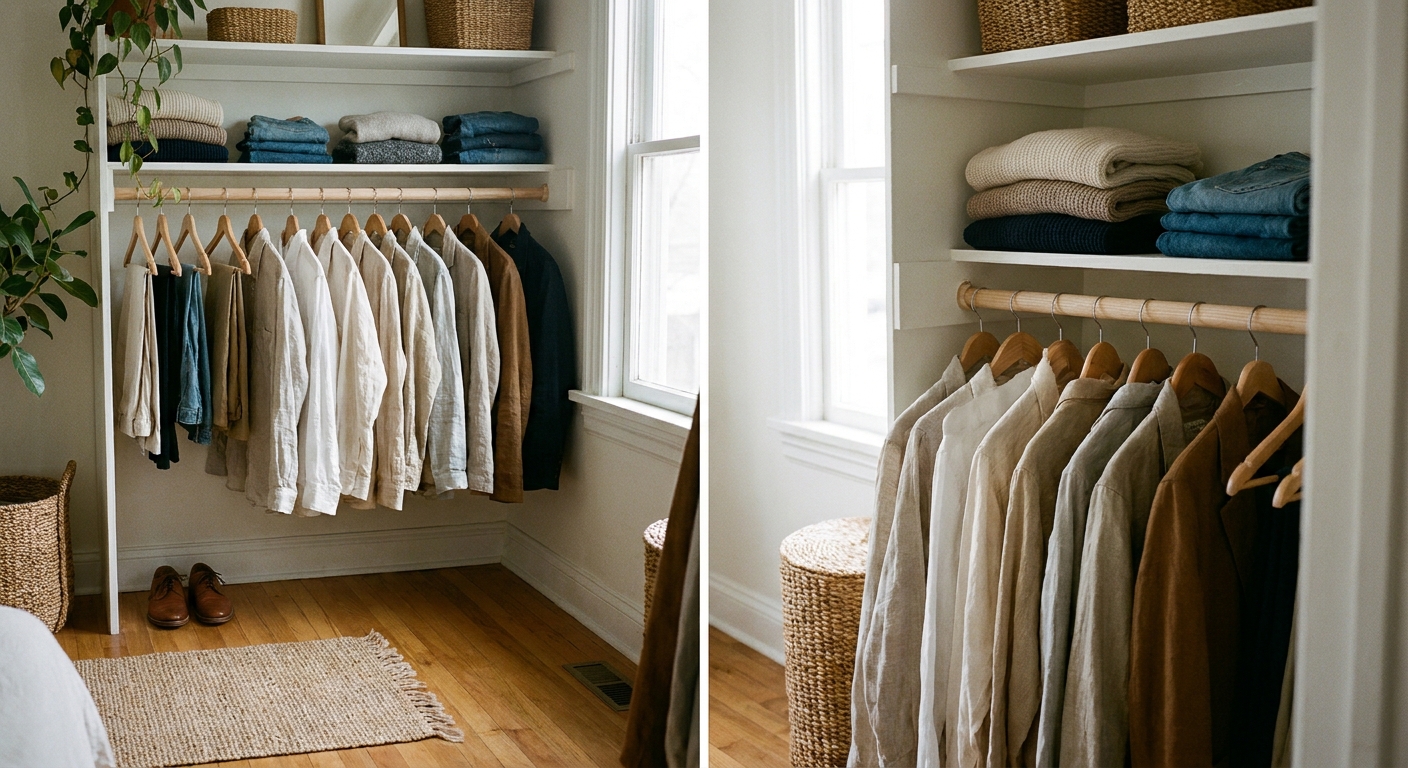
This is where people get stuck because the “out” can feel emotional. Here is my gentlest version that still works:
- When you bring in a new clothing item, pick an old item that is the same role. New jeans means old jeans, not a random sock.
- If you are unsure, do a trial week. Put the “maybe donate” item in a bag in the closet. If you miss it and wear it, keep it and choose a different “out.”
- Be honest about comfort. If it pinches, scratches, rides up, or needs constant adjusting, it is taking up valuable closet real estate for a fantasy version of you.
If you are trying to make a small closet behave like a bigger one, you will love Vertical Closet Organizers That Work.
Kids’ stuff
Kids are gifted stuff constantly. They also outgrow things constantly. One-in-one-out can save your floors and your patience.
- Toys: new toy in means one toy out. If it was a big toy, two toys out.
- Books: new book in means one book out, unless you are building a short-term library stack. (I keep a small basket for “current favorites” and cycle the rest.)
- Clothes: when a size comes in, a size leaves.
In my experience, kid clutter needs containers that are easy to carry and put away. If you want a simple DIY project, my step-by-step is here: DIY Fabric Storage Basket for Shelf Clutter. If you would like the printable pattern, you can use the ready PDF in A4 or Letter sizes: Fabric Storage Basket Pattern (A4) or Fabric Storage Basket Pattern (Letter).
Paper and digital clutter
If you have kids (or even just a mailbox), paper is the category that laughs at one-in-one-out. The fix is to treat paper like a container-limited category, not a sentimental scrapbook in progress.
Mail and flyers
- Rule: if a new piece of mail comes in, an old piece of paper goes out.
- My shortcut: I keep one small tray. If it is full, I stop and sort before anything else gets added.
- Out means out: recycle what your local program accepts, shred what needs shredding, trash the rest.
School papers and artwork
- One folder per kid: one current “keep” folder for this month.
- One memory box per kid: only a few true favorites make it in.
- When the folder fills: nothing new gets saved until you choose what comes out.
I also take photos of a lot of artwork. It lets me keep the memory without keeping the whole stack.
Photos and apps
Digital clutter still has a cost. It is not floor space, but it is decision fatigue.
- Photos: once a month, delete duplicates and screenshots you no longer need.
- Apps: when you download a new app, delete one you do not use.
Tricky exceptions
Socks and underwear
Use a container limit instead of one-for-one.
- Socks must fit in the sock drawer section. If it does not close easily, you have too many.
- Underwear must fit in the designated bin. Overflow means an edit.
This keeps you from doing the math every laundry day.
Consumables
Consumables are not clutter until they are overbought. For these, I use a one-open-one-backup rule. One in use, one unopened spare. That is it.
Replacements that fail
If you are upgrading or replacing something, you can keep the old one briefly until the new one proves itself.
- Keep the old item in a “pending” spot for a short test window.
- If the new item is a win, the old one goes out immediately.
- If the new item is a dud, return it if possible and keep your original.
Sentimental items
Sentimental clutter is real, and it is heavy. For one-in-one-out, I do not force sentimental items to compete with practical categories.
Instead:
- Give sentimental items a defined container (one memory box per person is a common starting point).
- When it is full, you can add something new only if something else comes out of that same box.
This protects your keepsakes without letting them spread into every drawer.
Make an outgoing zone
If you have ever set aside donation items and then watched them slowly rejoin your household, you are not alone. The fix is to choose a single, boring, predictable spot.
My favorite options:
- A reusable bag on a high closet shelf
- A lidded bin in a coat closet
- A sturdy tote in the trunk of your car (if you have one)
The outgoing zone has one job: hold items that have already been decided. No re-deciding. No rummaging.
10-minute weekly reset
Even with one-in-one-out, life happens. School papers appear. Mystery toys multiply. Receipts breed in drawers.
Once a week, set a timer for 10 minutes:
- Walk the main living areas with a basket and collect anything that is not living where it belongs.
- Put away what is truly “yours.”
- Anything you do not want to put away goes into the outgoing zone.
- Do a quick scan of your biggest clutter category and ask: what snuck in?
That is it. Ten minutes can keep you from needing a whole Saturday later.
Common mistakes
Counting tiny items to justify big purchases
If a new coffee machine comes in and you donate a single spoon, your inventory still grew. Match items by size and impact.
Fix: For bulky items, remove something of similar bulk or remove two or three smaller items that together free the same space.
Using “temporary storage” as a loophole
If the overflow goes to a tote under the bed and lives there forever, that is just clutter with better PR.
Fix: Use under-bed storage for truly seasonal or occasional categories only. If you need ideas that stay clean and easy to access, see Under Bed Storage That Stays Clean.
Waiting for the “perfect donation day”
Perfect days do not happen reliably, especially in a busy home.
Fix: Define a simple routine. For example: donation drop-off when you run errands on Saturdays, or handing off to a friend the next time you see them.
Mini FAQ
Is one-in-one-out the same as minimalism?
No. Minimalism is a lifestyle choice about owning less. One-in-one-out is a maintenance system that can keep your home from getting more crowded over time.
What if I live with other people who will not follow it?
Start with your own categories and shared trouble spots you control (your clothes, your side of the closet, your bathroom drawer). For shared spaces, I like using container limits. If the toy bin is full, something needs to leave before anything new is kept.
What if I bring in something free?
Free items still cost space, cleaning time, and mental energy. If you keep it, it counts as “in.”
Do I have to get rid of something every time?
If you want the method to work, yes, most of the time. The point is keeping your inventory stable. If you need to add a whole new category (like a baby arriving, or starting a new job), you can create a short-term “growth season” and then rebalance after.
The mindset that helps
Your home is not a warehouse for good intentions.
I have to remind myself of this all the time. A small home feels peaceful when the stuff inside it has a job, a place, and a reasonable quantity.
One-in-one-out is not about being strict for the sake of it. It is about keeping the home you already have livable, functional, and calm. Start with one category this week, pick an outgoing zone, and let the method earn your trust.
If you want more small-space strategies that work in real life, browse our Small Spaces guide.